
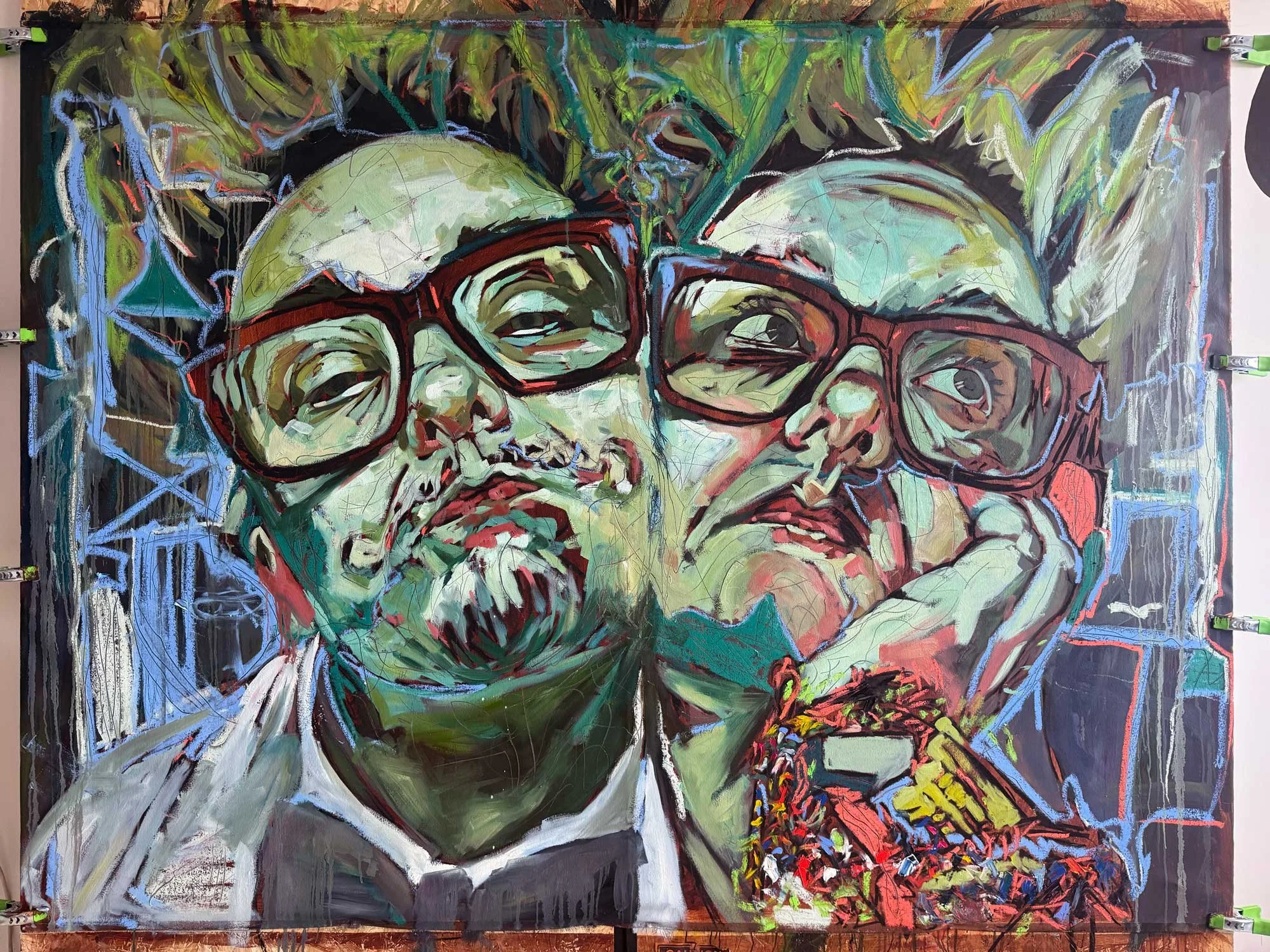
Cheek to Cheek III The final painting of 2026
At the beginning of this year, I wrote down a series of words. Under pressure. Catalyst. Shift. Fracture. Emotional weight. Under load. Density. I didn't necessarily know what I was going to do with them. They were just thoughts, fragments of something I was trying to understand. Looking back now, I think my subconscious was quite a few steps ahead of my rational thinking, because those words have somehow found their way into almost everything I've painted this year.
The work began with an interest in emotional pressure. How we carry things, how we respond to one another, how our faces and expressions change depending on what we're experiencing. The idea that we are never entirely fixed as individuals. That became the driving force behind Inner States. The Totems emerged through repetition, faces splitting, overlapping and stacking. I started using multiple heads as a way of exploring different emotional states occupying the same space. They weren't necessarily different people. They could be different versions of one person, or different moments in time. I became increasingly interested in that ambiguity, and somewhere along the way, the work turned inward.
Turning the work on myself
Cheek to Cheek began as a continuation of those ideas, except this time I was using myself. There are three paintings in the series now, each approaching the same idea differently. Two faces, two expressions, two versions of me, but I've never really seen them as two separate people.
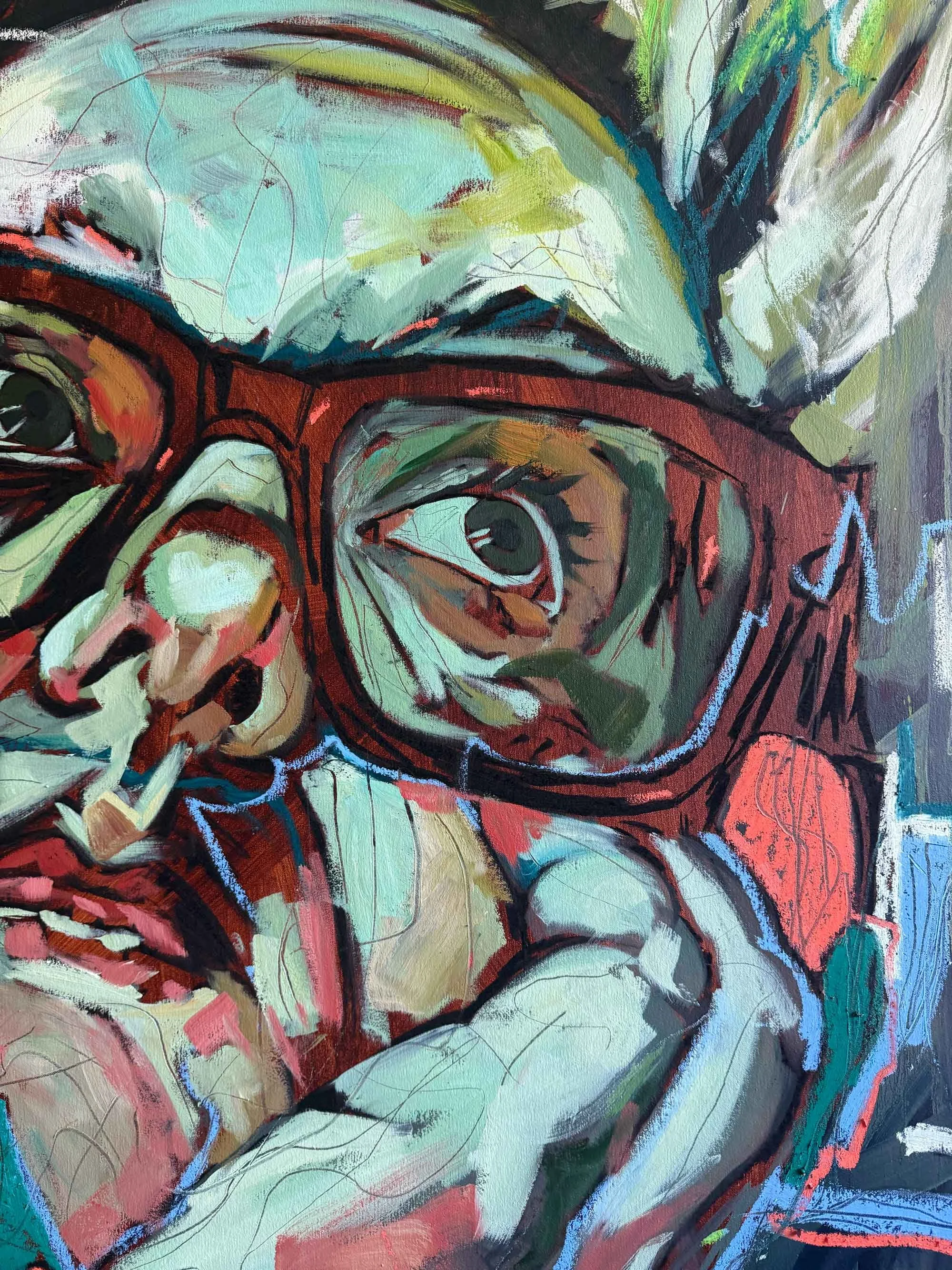
There's something about looking at yourself in this way that makes you confront things you might otherwise overlook. The relationship between masculinity and femininity, how you present yourself, how you feel, and how those things don't always sit neatly together. I've spent much of this year painting faces that seem to be shifting, colliding or existing somewhere between different states. With Cheek to Cheek III, I've brought those faces physically together. The heads press against one another, the glasses almost collide, the hair becomes entangled. There are still two expressions, two different attitudes, but they're occupying the same space. And when I look at it, I just see me. I just see me as one.
Seven feet of painting
I've wanted to paint at this scale for years. I've always admired painters who have not been afraid of size, such as Mark Rothko, Jackson Pollock, Jenny Saville, the list goes on. That ability to make a figure feel monumental, to have a painting occupy your entire field of vision. So I decided to do it.
Cheek to Cheek III is roughly seven feet by five and a half feet. It's fucking massive. There's something quite confrontational about making a painting of yourself at that size. You can't really ignore it. It demands space, and it demands that you stand in front of it.
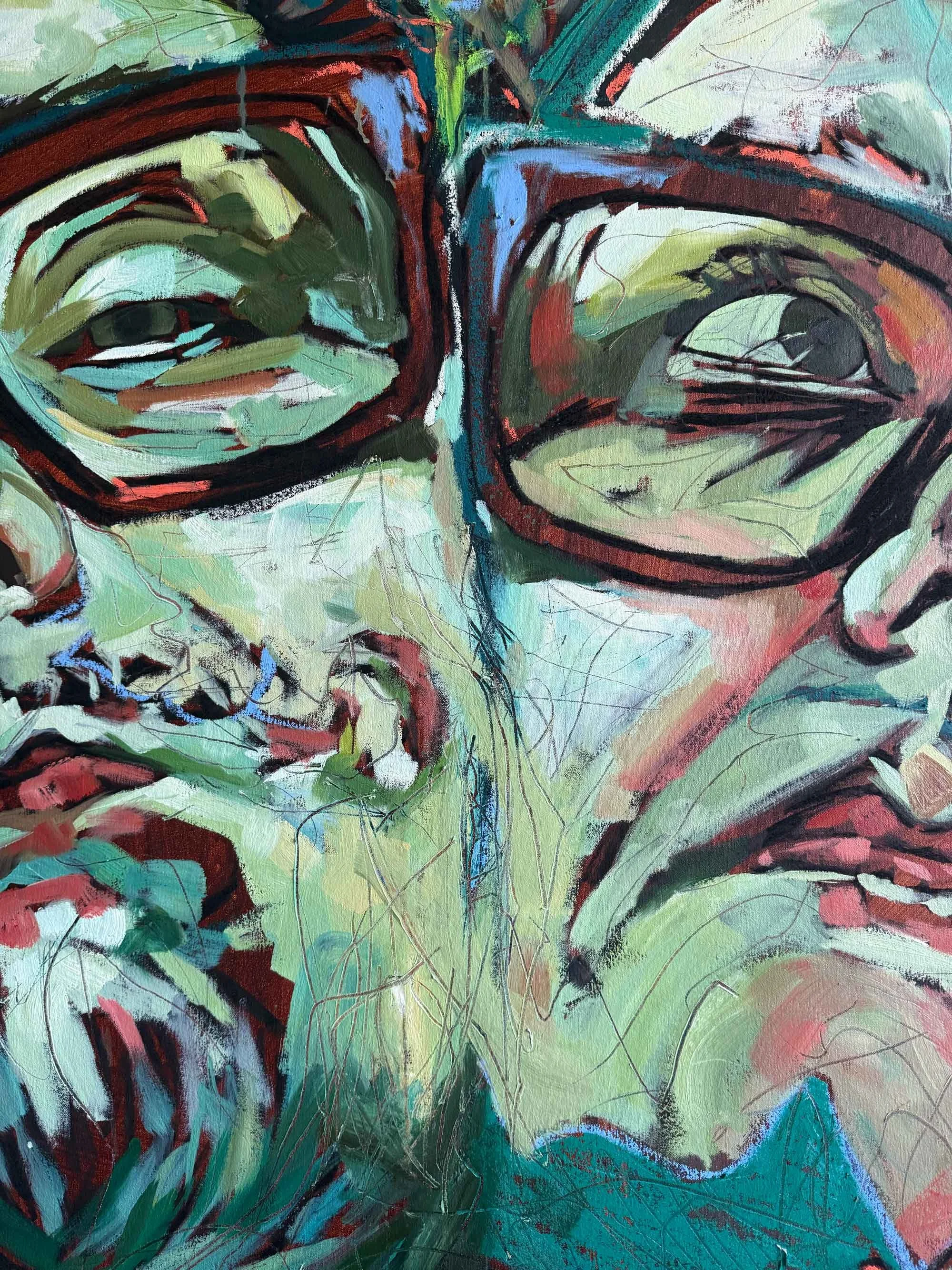
The painting took approximately 15 hours. I worked quickly, building from a dark, earthy ground, pushing colour into the faces and allowing the marks to accumulate. The greens have become increasingly important in my work. They're not there to describe natural skin tones. They seem to give the faces a different kind of intensity, something more emotionally charged and slightly unsettling.
There's a lot happening beneath the surface, too. Earlier drawing, changes of direction, marks that have been partially painted over and others that remain completely exposed. I like that you can still see the history of the painting, the decisions I've made, the ones I've abandoned and the things that have survived.
Is it finished?
I'm not entirely sure. There are areas I could go back into, passages that could be developed further, edges that could be resolved, things I could bring together. But I'm also not particularly bothered if I leave it exactly as it is, and that's quite an interesting position to be in.
There's a tendency when painting to keep working until everything feels resolved. But I'm becoming less convinced that resolution is always necessary. Some of my favourite passages are the ones where you can still see the original drawing, the earlier decisions, the bits that haven't been completely tidied away. There's something appropriate about that, particularly in a painting concerned with identity and change. Perhaps it doesn't need to be entirely resolved. Perhaps I don't either.
Knowing when to stop
This is my final painting of 2026. Not because I've run out of ideas, quite the opposite, but because I feel I've reached the point I needed to reach this year. When I look back at those early notes about pressure, emotional weight and shifting states, I can see how much of that thinking has become part of the work. What began as a collection of words has developed into something physical.
I've spent the year exploring those ideas through other faces, through the Totems, through the exhibitions, and eventually through myself. And now I've made this enormous painting. I genuinely can't imagine following it with something smaller just for the sake of continuing to paint. What would be the point?
I want to give myself some room now. Some time without painting, without constantly constructing compositions in my head or wondering what the next canvas might look like. I need that space to make room for whatever comes next. There are still things happening around the work, including an open call I intend to pursue, but the actual painting can stop for a while.
I don't think this is the end of Inner States, or even necessarily the end of the questions I've been asking. It's simply where I've arrived. Three Cheek to Cheek paintings, an entire year of looking at how we shift and change, and finally this enormous confrontation with myself.
And for now, that's enough.
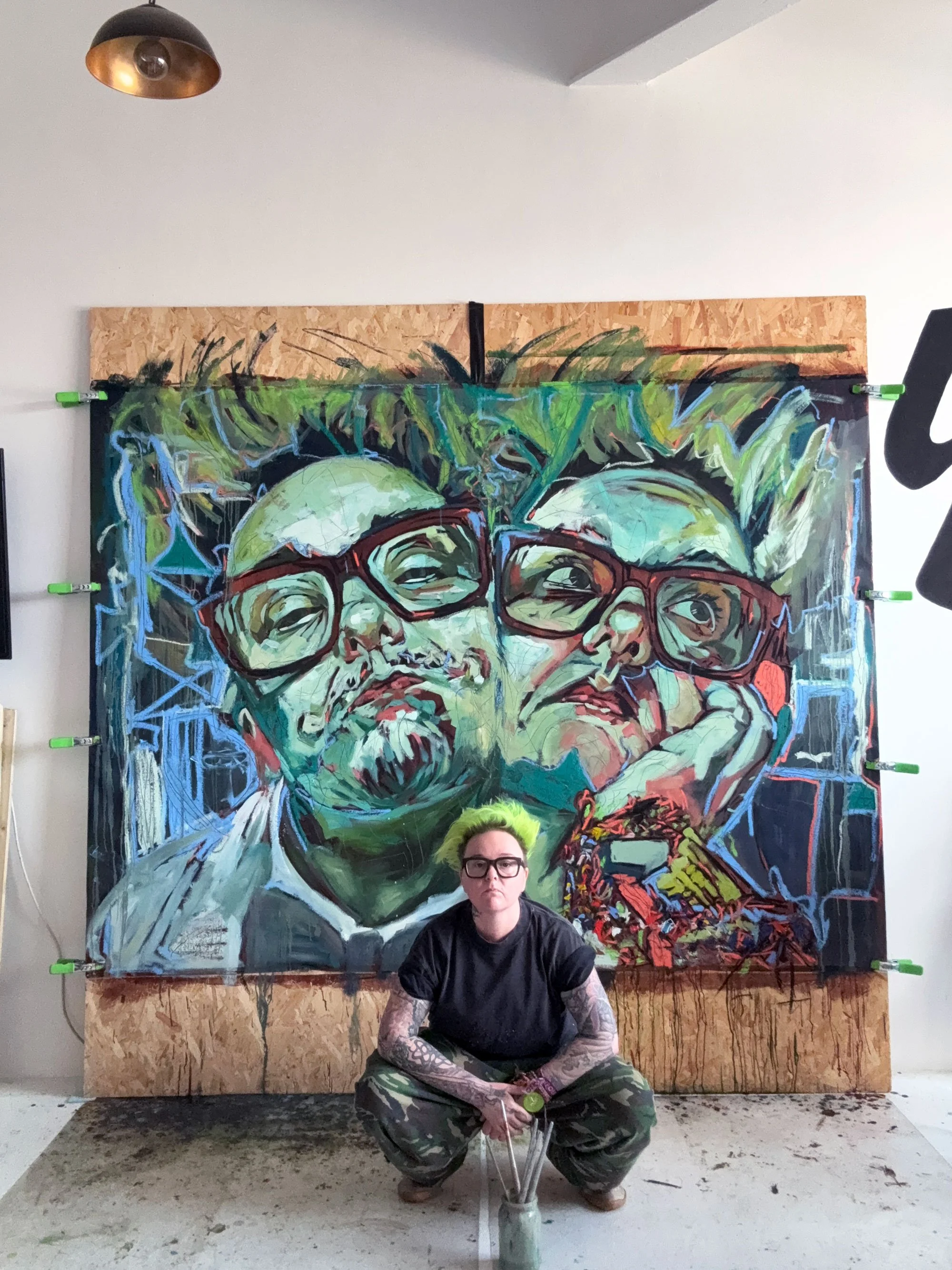
Cheek to Cheek III (2026)
Oil, oil stick and charcoal on 407gsm universal-primed cotton duck canvas, medium grain, unstretched.
Approx. 213 × 183 cm (W × H)