
Cheek to Cheek, Out in the Open
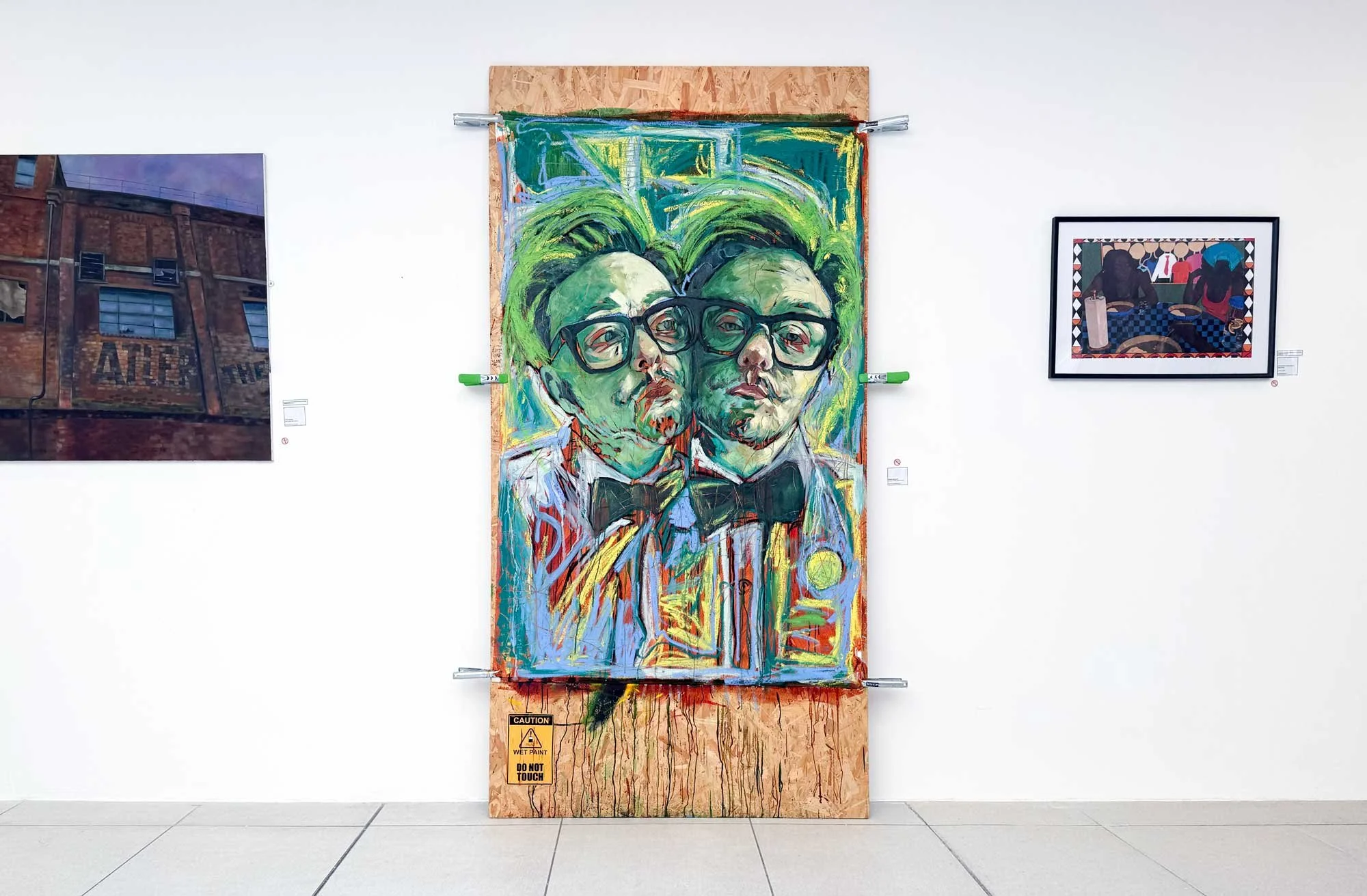
Cheek to Cheek, Self-Portrait, 2026. Oil and oil stick on unstretched 400gsm primed canvas, 183 × 120 cm. Currently clamped to an 18mm OSB board, 244 × 122 cm, for Common Ground at the Round Room, Zellig.
At the moment, Cheek to Cheek II is hanging in the Round Room at Zellig as part of Common Ground, an exhibition curated by Kristina Hall, bringing together artists from across Birmingham and the Black Country.
The exhibition opened on 29 August and runs until 5 September. And for me, there is something really lovely about it being here because Zellig is literally next door. My studio is over in Scott House, on the second floor, and it takes me approximately five minutes to walk from Studio 217 to the Round Room. So, technically, I have managed to exhibit my work about as close to home as it is possible to get. But it feels like more than that.
Scott House and Zellig are neighbours, but they can sometimes feel quite dislocated from one another. I know there are loads of creative people working over there, but our paths do not necessarily cross. Being involved in Common Ground has somehow bridged that gap. It has introduced me to Kristina and to artists I had never met before, alongside a handful of people I already knew through UASB. It has made the whole place feel more connected.
The Round Room is also just a really great space. It is full of light, right beside the courtyard and in the middle of all the movement and general hustle and bustle of Gibb Street. Hundreds of people pass through it every day.
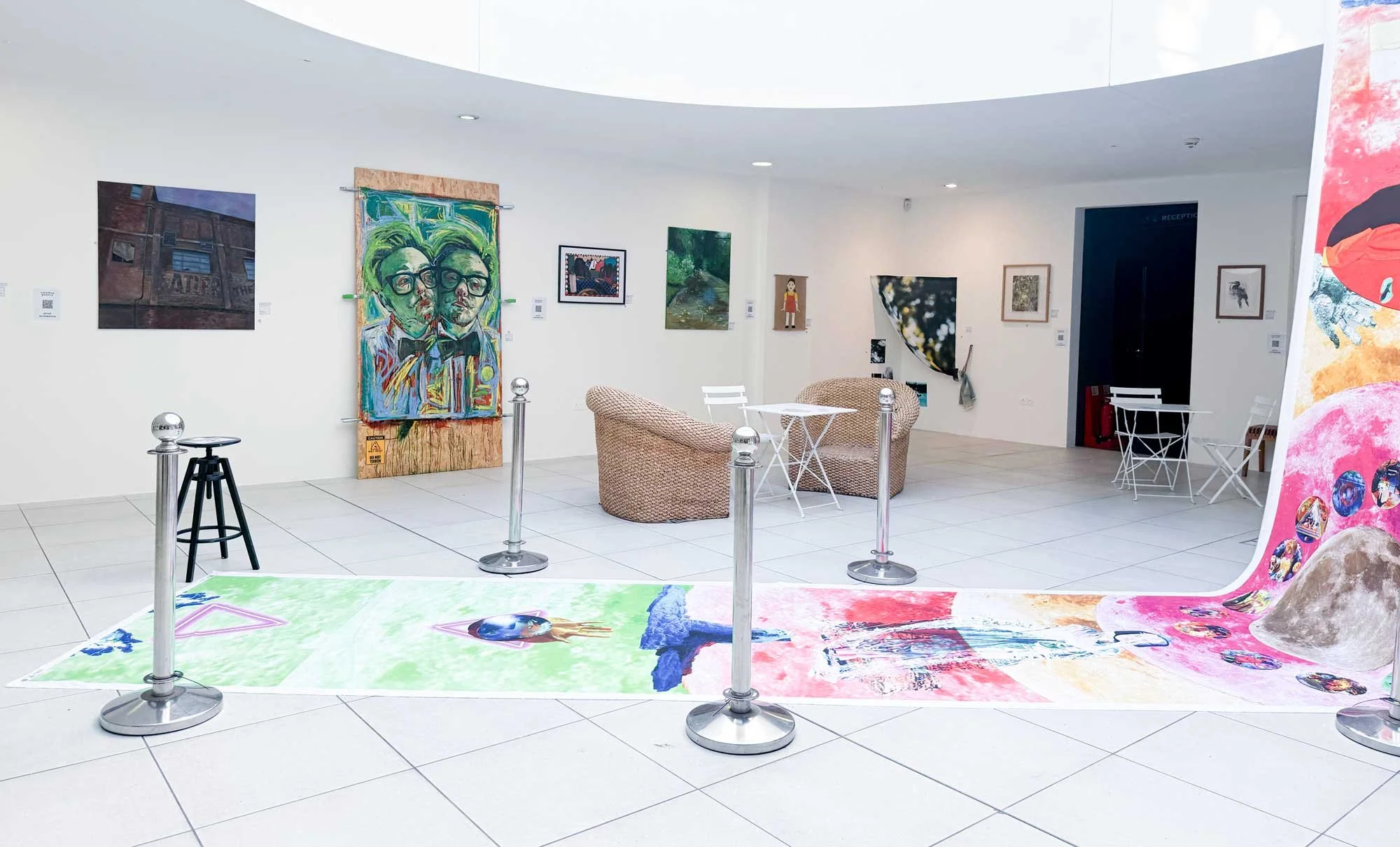
Common Ground came through an open call and there was no set theme. Everyone has brought something from wherever they happen to be in their practice right now. I really like that because the exhibition has become a kind of snapshot of what a group of artists from across the region are currently thinking about, investigating and making. For me, that work is Cheek to Cheek.
Over the past few months, a new branch of work has started growing out of the Totems I made for Inner Worlds. Those paintings were about multiplicity and the idea that we never remain completely fixed as people. They showed the same person stacked vertically, heads pressing down on one another, each one carrying a different feeling or state of mind.
After the exhibition finished, I started wondering what would happen if I turned that pressure sideways. What if I took two versions of the same person and pushed them together from opposite directions?
The idea actually came from placing two exhibition catalogues next to one another. Each cover showed half a face and, when they met, the two halves completed the image. That led to one experiment, which led to another, and eventually became Cheek to Cheek.
And what better person to experiment on than myself?
I use self-portraiture as a kind of barometer. It allows me to check where I am, not only in my life, but in my painting. How has my mark-making changed? How much have I loosened up? How far can I push something without over-resolving it and painting all the life out of it?
At the same time, I had started thinking of the studio as a laboratory and the paintings as the outcomes of a series of questionable experiments. I had green hair, green paintings and a test-tube emoji full of green liquid. It all began to align into this slightly crazed, bohemian scientist persona. Think Doc Brown, Weird Science and Honey, I Shrunk the Kids, with a dickie bow, black-rimmed glasses and paint thrown all over a lab coat. It started as something funny, but then something else began to emerge from it.
I painted on a Dalí-esque moustache and goatee and photographed myself in this much more masculine, androgynous way. I had also started looking at Claude Cahun and their androgynous self-portraits, particularly the way they used doubling, mirrors and performance to challenge how identity is presented. Somewhere along the way, my mad scientist became a kind of drag king. It felt liberating, but it was also a bit scary!
I often think an idea lands in my subconscious first and then I have to catch up with it. That is what happened here. What started as a joke, or a visual extension of the questionable experiments, became a genuine exploration of androgyny, masculinity and a side of myself I had never presented so openly before.
There has always been ambiguity in my work. I do not think everything needs to be explained, and I still do not know where this will lead. I am not trying to pre-empt the next body of work or arrive at some neat conclusion about myself. But I do know that Cheek to Cheek is important.
Something that began privately in the studio as an experiment is now right in the middle of Zellig, with hundreds of people walking past it every day. My face is there, doubled, masculine, fragmented and unresolved. My name is attached to it.
In some ways, it feels like being outed by my own painting. Except, of course, I am the one who put it there.